
Industrial equilibria for 14-16.
1. Ammonia made in the Haber-Bosch Process

REDUCE THE TEMPERATURE.
RAISE THE PRESSURE.
USE MORE IRON CATALYST.
INCREASE THE [HYDROGEN].
Forward reaction is exothermic
It counteracts the change.
The equilibrium shifts to the right
The yield of NH3 increases.
But the reactions slow down.
450 o C is the optimum temperature — producing ammonia with the lowest costs.
Forward reaction reduces the number of molecules of gas.
It reduces pressure and counteracts the change.
The yield of NH3 increases.
The reaction rates increase.
But maintaining higher pressures is expensive. 200 atm is optimum.
The catalyst speeds up the rates of the forward and reverse reactions (equally).
The equilibrium is established faster — but the position of the equilibrium is unchanged.
The yield of NH3 is unchanged.
The forward reaction uses up H2.
It counteracts the change.
There is no industrial advantage.
The gases react in the ratio 3:1 and are supplied in this ratio.
Removing the ammonia is done by simply cooling the mixture.
2. Sulfuric acid made in the Contact Process.
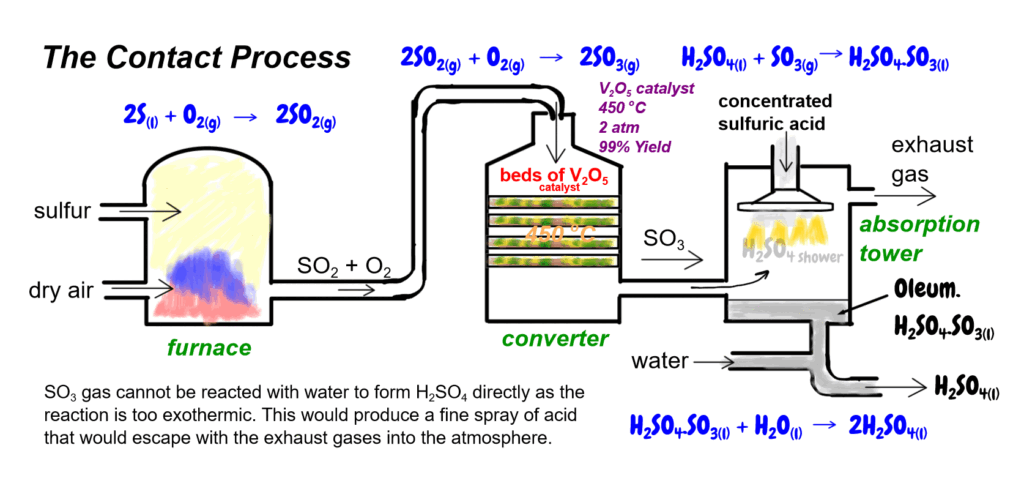
STAGE 2. Converting SO2 gas to SO3 gas.
2SO2 (g) + O2 (g ) ⇌ 2SO3 (g) ΔH = – 200 kJ/mol
CONDITION USED: 450 o C and around 2 atmospheres
CATALYST: Vanadium pentoxide V2O5 (s)
PERCENTAGE YIELD: Around 99 %
NOTE: Sulfuric acid has a variety of useful properties –
explaining why it is the mostly widely used substance
in chemical manufacturing.
H2SO4 is used in manufacturing:
fertilisers, pigments, dyes, drugs, explosives, detergents,
as well as in petroleum refining and metal production.
Question 1. What happens to the yield of SO3 gas
if the temperature is lowered to 400 o C?
Explain your answer.
Answer 1. Highlight the space below to reveal the answer ⇓
- The yield of SO3 increases.
- The forward reaction is exothermic as ΔH is negative.
- It speeds up as it counteracts the change.
- The equilibrium shifts to the right, making more SO3 gas.
Question 2. Why isn’t a lower temperature used, in order to improve the
yield of SO3 gas?
Lowering the temperature would slow the forward and reverse reactions down, so it would take longer to establish the equilibrium.
450 o C is the optimum temperature.
Question 3. What happens to the yield of SO3 gas
if the pressure is raised?
Explain your answer.
The forward reaction reduces the total number of molecules of gas.
This speeds up as it reduces the pressure and counteracts the change.
The equilibrium then shifts to the right and the yield increases.
Question 4. Why isn’t a higher pressure used to increase the yield?
The yield is already very high (99 %) at low pressure.
There is no financial incentive to increase the pressure.
3. Nitric acid made in the Oswald Process.

Question 5. STAGE 1. 800 o C with a platinum-rhodium catalyst
⇒ gives an approximate yield of 95 %.
4NH3 (g) + 5O2 (g) ⇌ 4NO (g) + 6H2O (g) ΔH = – 906 kJ/mol
Explain why applying pressure will have no benefit, apart from speeding up the reactions.
The forward reaction increases the number of molecules of gas.
Raising the pressure would speed up the reverse reaction as it counteracts the change, and the yield would decrease.
4. Hydrogen made in Steam Reforming
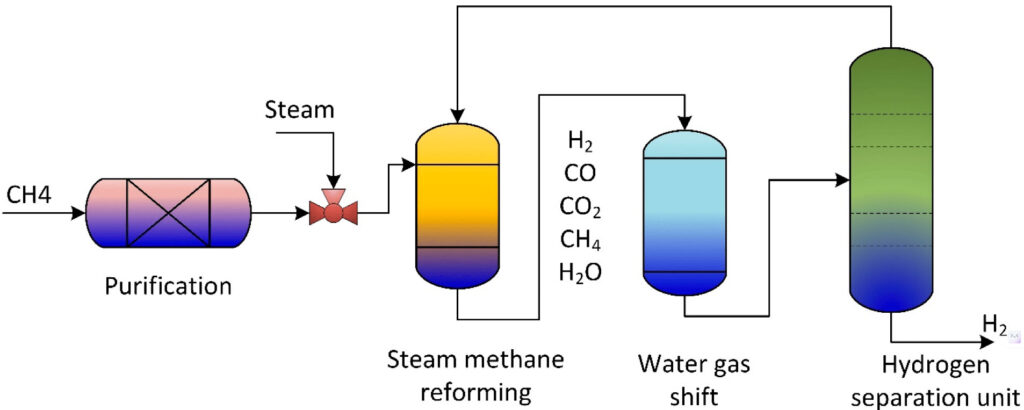
CH4 (g) + H2O (g) ⇌ CO (g) + 4H2 (g) ΔH = + 206 kJ/mol
Question 7. Should high or low temperatures and pressures be used here to obtain the highest yield of hydrogen gas? Explain.
- High temperature
The forward reaction is endothermic as it has a positive ΔH.
It will speed up as temperature rises as it counteracts the change. - Low pressure
The forward reaction increases the number of molecules of gas.
It will speed up as pressure decreases as it counteracts the change.
Question 8. The carbon monoxide formed as a byproduct can also be reacted with steam to produce more hydrogen.
CO (g) + H2O (g) ⇌ CO2 (g) + H2 (g) ΔH = -41 kJ/mol
Again, should high or low temperatures and pressures be used here to obtain the highest yield of hydrogen gas? Explain.
- Low temperature
The forward reaction is exothermic as it has a negative ΔH.
It speeds up when temperature is lowered,
as it counteract the change. - Pressure has no influence on the yield.
There is no change in the number of moles of gas.