
Use of 2,4-DNPH to
distinguish carbonyls from other organics.
2,4-dinitrophenylhydrazine + Carbonyls
⇓ BELOW: Discussion of the condensation reaction. ⇓
⇓ BELOW: Demonstration of the condensation reaction. ⇓
CH3CHO + C6H3(NO2)2NH—NH2 → C6H3(NO2)2NH—N—N = CH(CH3) + H2O
Mechanism, if you are required to know it.

⇓ BELOW: Animated and narrated mechanism. ⇓
PRACTICAL: Identifying a specific aldehyde or ketone
The steps of isolating the solid derivative, purifying it by recrystallization, finding its melting point, and comparing it to known values:
Preparing the Solid Derivative of the carbonyl and 2,4-DNPH:
- Start by preparing the 2,4-DNPH reagent.
Dissolve 2,4-DNPH in a solvent such as ethanol or methanol.
The resulting solution is typically yellow-orange in colour. - Take a small sample of the unknown compound containing an aldehyde or ketone functional group.
- Add a few drops of the 2,4-DNPH reagent to the sample and mix well.
- Allow the mixture to stand at room temperature for a few minutes. If the compound is an aldehyde or ketone, a yellow to orange-red precipitate (the 2,4-DNPH derivative) will form.
A few drops of sulfuric acid may be required to help a ppt form.
- Start by preparing the 2,4-DNPH reagent.
Isolating the derivative:
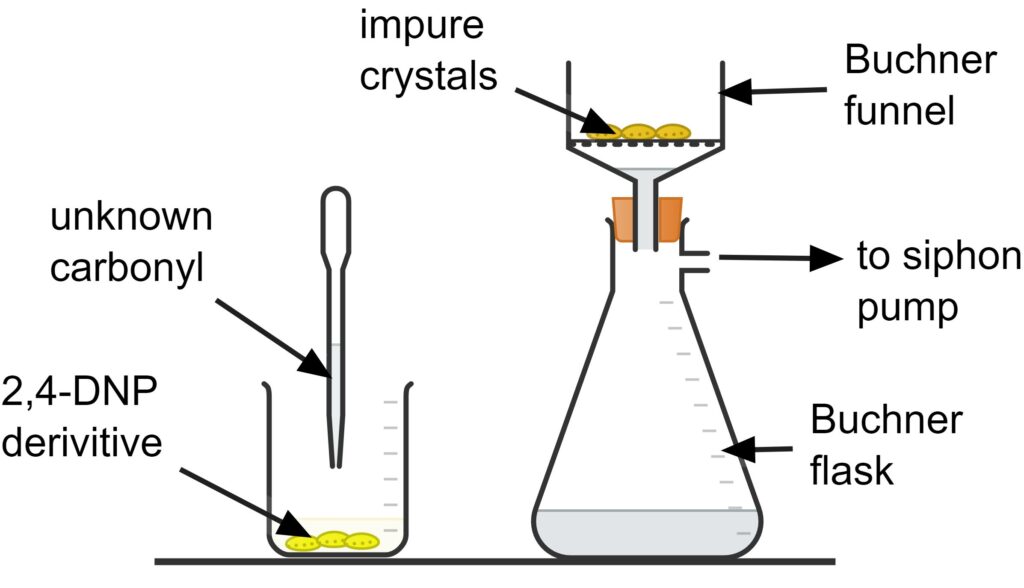
- Carefully isolate the solid precipitate by vacuum filtration.
- Allow the solid to air dry or gently blot it with filter paper to remove any residual solvent.
- Purification by Recrystallisation.
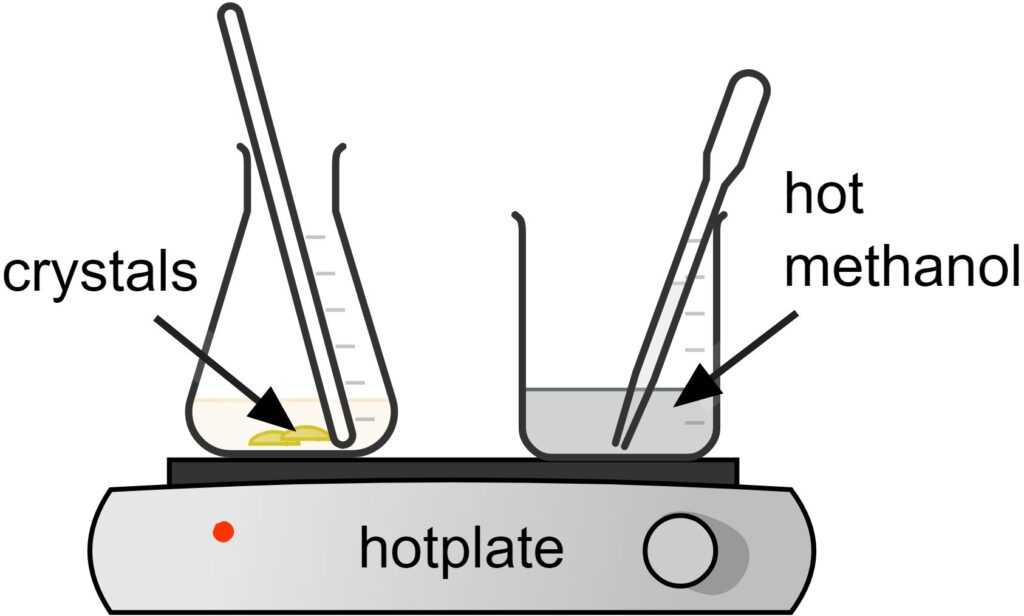
1. Transfer the residue to a small beaker and place it on a hotplate.
2. Add a few drops of hot (but not boiling) methanol or ethanol.
3. Stir and continue adding drops until the solid just dissolves.
That is, use the minimum volume of hot solvent.
4. If some solid remains insoluble, filter while hot, using hot
stemless funnel and conical flask, and fluted filter paper.
5. Allow the solution to cool and the product will recrystallise.
6. Isolate the crystals of the derivative using vacuum filtration.
7. Wash the residue with a little cold solvent and dry. Finding the Melting Point:
- Place a small amount of the purified 2,4-DNPH derivative in a melting point capillary tube.
- Insert the capillary tube into a melting point apparatus.
- Gradually heat the sample at a controlled rate, typically 1-2 degrees Celsius per minute.
- Observe the temperature at which the solid begins to melt and record this as the melting point of the derivative.
Comparing the Melting Point:
- Compare the observed melting point of the derivative to known values for various aldehydes and ketones.
- Each aldehyde or ketone has a characteristic melting point range for its 2,4-DNPH derivative.
- A close match between the observed melting point and a known value can help identify the specific aldehyde or ketone in the unknown compound.

⇐ Sample from a table with known values of melting points of derivatives.
