
Define the terms:
Standard Solution andPrimary Standard For example: sodium carbonate: Na2CO3. Molar Mass = 105.99 g/moland potassium hydrogen phthalate (KHP): C8H5KO4. = 204.23 g/mol
A Standard Solutions is one of accurately known concentration. These solutions are used to help identify and determine the concentration of a substance whose concentration is unknown. A primary standard must meet four key criteria. It must: be available with extremely high purity be stable under the conditions in which it is used & stored have no water of hydration and have no tendency to become hydrated be of high molecular mass to minimize the effect of small weighing errors
How would you prepare a STANDARD SOLUTION:
Moles of NaHCO3: n = c.v = 0.25 x 0.500
From a stock solution of 2.00 moldm-3 copper (II) sulfate solution
how would you prepare 250 cm3 of a copper (II) sulfate solution with a concentration 0.20 moldm-3
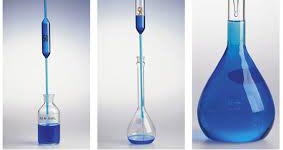
PIPETTE 25.0 cm3 of the stock solution into a 250 cm3 VOLUMETRIC FLASK. Fill the volumetric flask up to the mark using deionised water. Stopper and shake the flask. This means you have the correct volume, and as 25 is 1/ 10 of 250 the new concentration is 0.20 moldm-3
From a stock solution of 1.00 moldm-3 iodine solution I2(aq)
how would you prepare 20.0 cm3 of an iodine solution with a concentration 0.40 moldm-3
The new solution needs to be 4/10 the concentration of the stock solution. PIPETTE 8.0 cm3 of the stock solution into a test tube. PIPETTE 12.0 cm3 of deionised into the test tube. You now have the correct volume (20 cm3) of which 8.0 cm3 is the stock solution.8/20 = 4/10 = 0.4 moldm-3 in concentration.